
If you are looking for fae names, the best choices usually sound otherworldly without becoming difficult to pronounce or remember. Fae-inspired naming can draw from flowers, forests, moonlight, old folklore, Celtic and Persian traditions, magical creatures, and the elegant names often associated with fantasy courts.
The term fae is also broader than the modern image of a tiny winged fairy. Traditional folklore and modern fantasy use the idea in different ways, so a fae character might be gentle and luminous, mysterious and ancient, mischievous, or even dangerous. Modern naming resources commonly combine nature-inspired words with lyrical personal names, while established names such as Fay, Pari, and Parisa have genuine connections to fairy-related meanings.
Below, you will find carefully selected names for different fae personalities, along with real names connected to fairy traditions and original fantasy-style options.
Best Fae Names
These are strong all-purpose choices when you want a name that immediately feels magical but still works for a memorable character.
- Elowen — A graceful, woodland-feeling choice with a soft fantasy sound.
- Fay — A particularly direct choice; the English name is connected with the word fay, meaning fairy.
- Nimue — An elegant Arthurian-inspired choice with an unmistakably legendary atmosphere.
- Sylvie — Soft and natural, making it suitable for a gentle forest fae.
- Aurelia — A bright, refined choice for a character associated with golden light.
- Briar — Beautiful but thorny, ideal for a fae who seems sweet but has a dangerous side.
- Rowan — A compact nature name that suits a woodland guardian.
- Vesper — Darker and more mysterious, with a strong twilight atmosphere.
- Pari — A genuine Persian name meaning “fairy, sprite, nymph.”
- Titania — A classic literary choice associated with the fairy queen in Shakespeare’s A Midsummer Night’s Dream.
- Oberon — A distinguished choice for a powerful male fae, also associated with Shakespeare’s fairy king.
- Aisling — An Irish name with a dreamy, poetic quality that works especially well in fantasy settings.
- Thistle — A playful nature choice with an unexpectedly prickly edge.
- Liora — A luminous-sounding option for a radiant or benevolent character.
- Maeve — Short, elegant, and well suited to a commanding fae noble.
Female Fae Names
For feminine fae characters, lyrical names work particularly well. The strongest options do not all need to sound delicate; names inspired by thorns, night, ancient legends, and wild landscapes can create more interesting personalities.
- Elowen
- Nimue
- Aurelia
- Sylvie
- Maeve
- Aisling
- Liora
- Seraphine
- Eira
- Elara
- Isolde
- Linnea
- Rosalie
- Maris
- Ophelia
- Celeste
- Faye
- Briar
- Willow
- Iris
Faye deserves special attention if you want a name directly associated with the fae concept. It is a variant of Fay, which has a documented connection to the English word fay and ultimately older terms associated with magical or enchanted beings.
Male Fae Names
Male fae names can lean elegant, wild, ancient, or mischievous rather than simply sounding like conventional fantasy warrior names.
- Oberon — Regal and immediately recognizable as a fairy-court name.
- Puck — A mischievous literary choice associated with Shakespeare’s fairy world.
- Rowan — Natural and understated.
- Ash — Short, earthy, and easy to remember.
- Alder — A strong woodland-inspired choice.
- Orion — Suits a mysterious character with a celestial connection.
- Evander — Refined and adventurous.
- Sylvan — A natural fit for a forest-dwelling character.
- Finnian — Soft enough for a friendly fae but substantial enough for a protagonist.
- Lorien — A more overtly fantasy-styled choice.
- Cedar — Earthy and distinctive.
- Ronan — Compact and lyrical.
- Caelan — A smooth choice for an elegant fantasy character.
- Theron — Works well for a more serious or formidable fae.
- Fenn — Short and slightly mysterious.
Gender-Neutral Fae Names
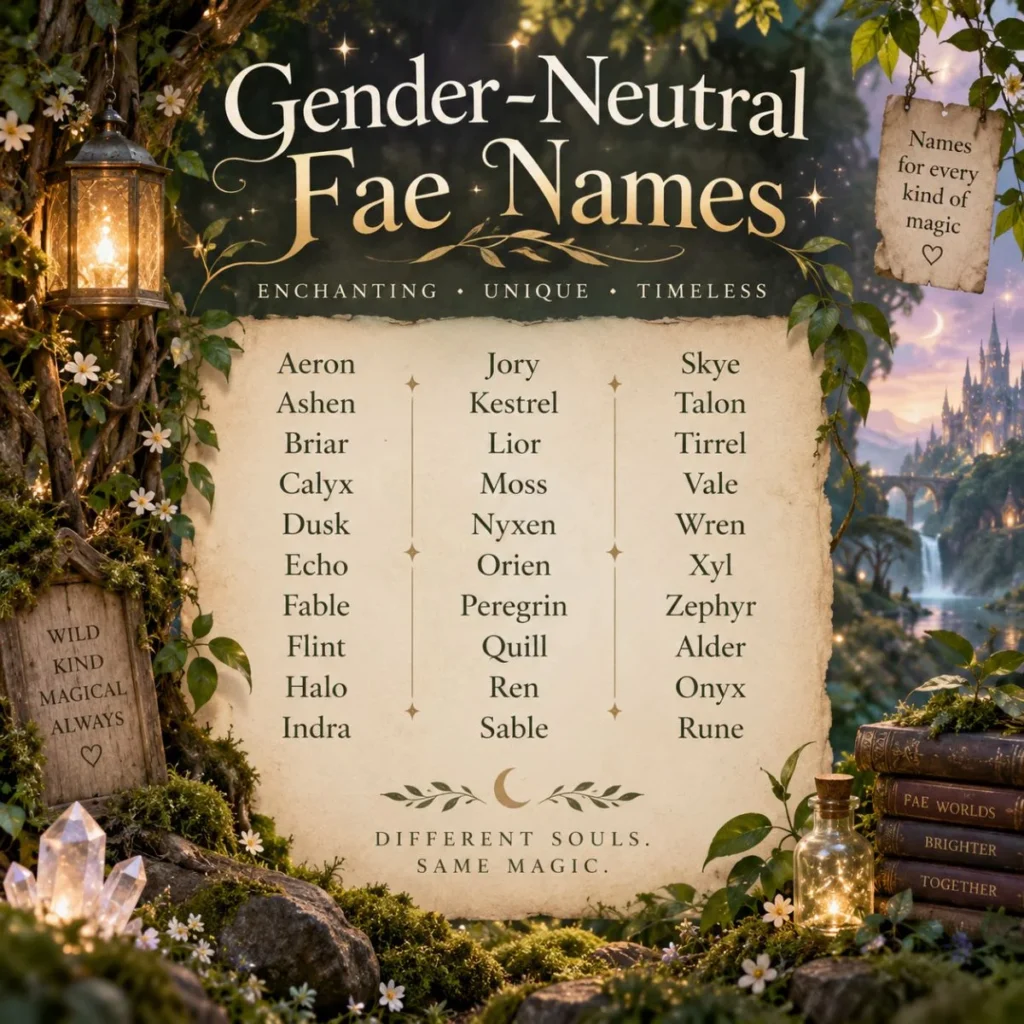
If you are naming a character whose identity is intentionally fluid, or simply want a name that does not suggest a particular gender, these options offer plenty of flexibility.
- Aster
- Briar
- Rowan
- Wren
- Ash
- Vale
- Lumen
- River
- Ember
- Fern
- Moss
- Raven
- Sage
- Rain
- Vesper
- Clover
- Lark
- Dawn
- Sorrel
- Winter
Nature names are particularly effective here because they describe an atmosphere or association rather than a conventional human identity.
Cute Fae Names
Cute fae characters benefit from shorter names, gentle sounds, and playful references to flowers, small creatures, light, and woodland objects.
- Pip
- Tilly
- Posy
- Mimi
- Poppy
- Dew
- Petal
- Clover
- Bumble
- Dottie
- Lumi
- Bibi
- Pippa
- Mallow
- Nettle
- Tansy
- Bluebell
- Twinkle
- Peaches
- Flicker
For a tiny garden fae, Posy, Dew, Petal, and Tansy feel especially natural. A playful character, meanwhile, could carry something deliberately lighthearted such as Pip or Bumble.
Dark Fae Names
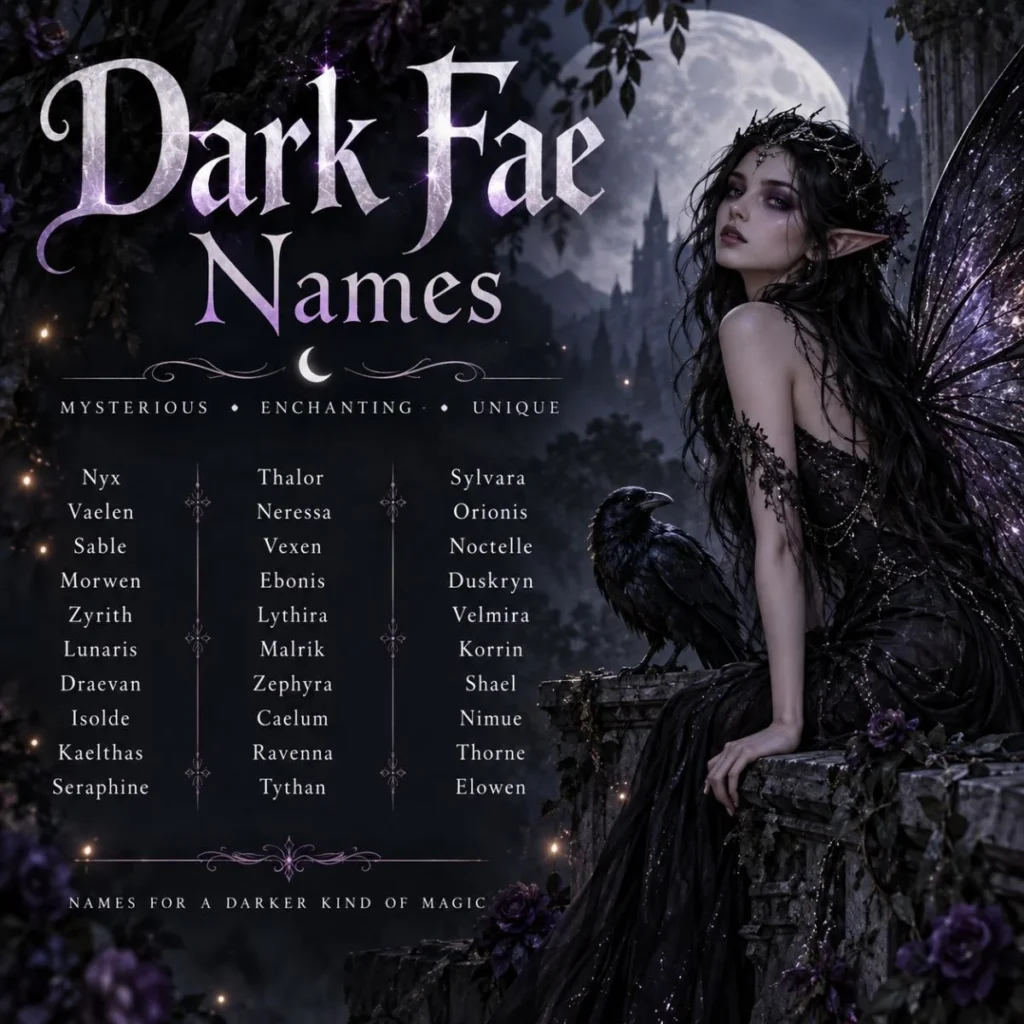
Not every fae should feel sweet and glittering. Darker names are better suited to ancient court members, night spirits, tricksters, cursed characters, or fae who make dangerous bargains.
- Vesper
- Raven
- Nyx
- Briar
- Thorn
- Morrow
- Onyx
- Sable
- Hollow
- Wraith
- Nocturne
- Riven
- Shade
- Duskwyn
- Velora
- Morwen
- Ebon
- Nightshade
- Grimthorn
- Vael
For a dark fae, restraint often works better than piling several ominous words together. Vesper or Morwen can feel more convincing than an overly elaborate combination such as “Dark Shadow Night.”
Nature-Inspired Fae Names
Nature is one of the most reliable sources of fae naming inspiration. Contemporary fairy-name resources frequently organize names around flowers, trees, weather, woodland settings, and other natural imagery.
- Willow
- Hazel
- Ivy
- Fern
- Aster
- Clover
- Juniper
- Foxglove
- Primrose
- Marigold
- Bluebell
- Heather
- Moss
- Bramble
- Linden
- Wren
- Lark
- Sorrel
- Saffron
- Honeysuckle
- Cedar
- Aspen
- Laurel
- Meadow
- Brook
These names are especially useful when the character belongs to a particular environment. Moss and Fern suit a damp woodland, while Marigold and Bluebell suggest a brighter garden setting.
Celestial Fae Names
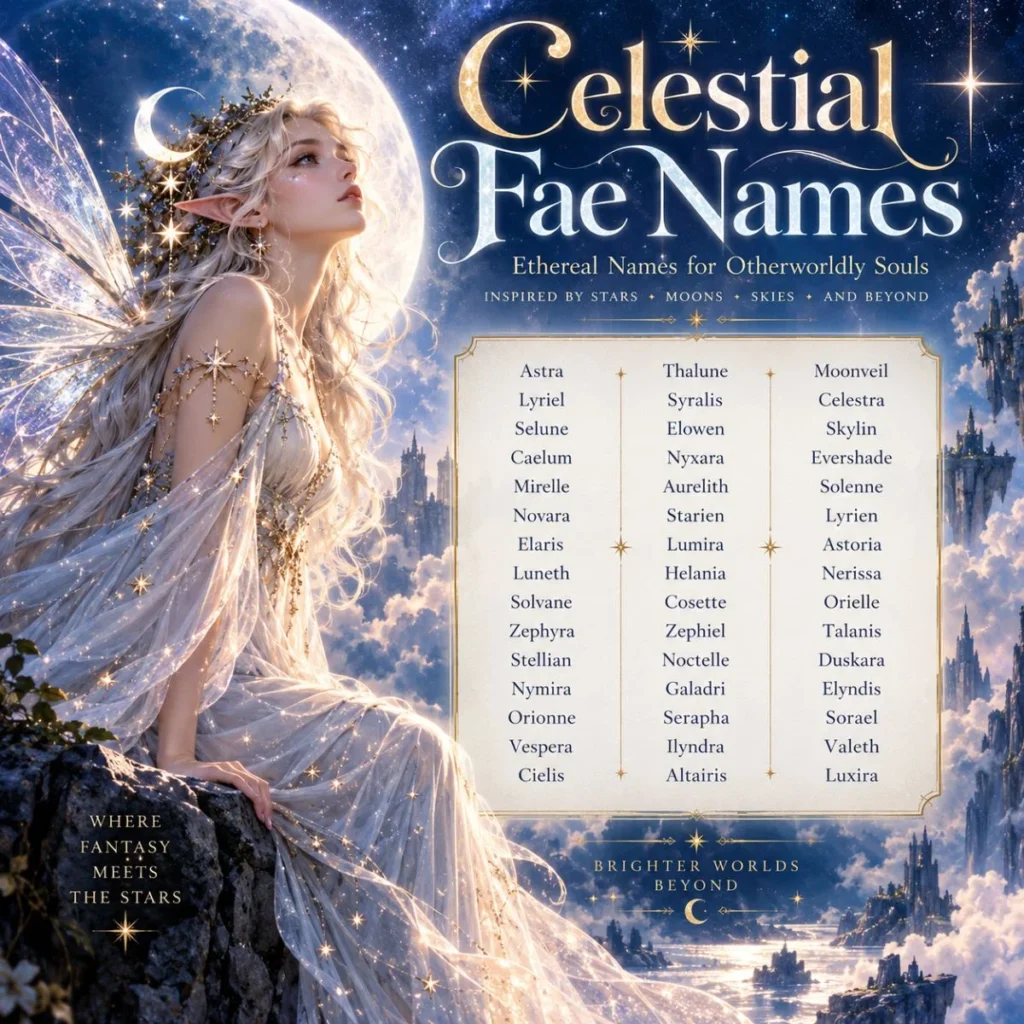
Moonlight, stars, dawn, and twilight create a different type of magical atmosphere. These names work particularly well for sky fae, night courts, seers, dream spirits, and characters associated with celestial magic.
- Luna
- Selene
- Nova
- Stella
- Elara
- Lyra
- Vesper
- Celeste
- Aster
- Sol
- Dawn
- Aurora
- Estelle
- Seren
- Eclipse
- Moon
- Comet
- Astrid
- Halo
- Lumen
Choose Luna or Celeste for a softer character. Vesper and Eclipse create a more mysterious impression, while Sol and Aurora feel brighter.
Fae Names With Real Fairy Meanings
If meaning matters more to you than simply achieving a fantasy sound, it helps to separate established names from names invented for fictional settings.
Fay is one of the clearest English choices. Its documented history connects it with fay, meaning “fairy,” while the word itself has roots passing through Middle English and Old French.
Pari is a Persian name meaning “fairy, sprite, nymph.”
Parisa is also Persian and means “like a fairy,” deriving from parī, a word associated with a fairy or supernatural being.
Other documented fairy-related names include Diwata, a Tagalog name meaning “goddess, nymph, fairy,” and Keijo, a Finnish name derived from keiju, meaning “elf, fairy.”
- Fay — English; associated directly with “fairy.”
- Faye — Variant spelling of Fay.
- Pari — Persian; “fairy, sprite, nymph.”
- Parisa — Persian; “like a fairy.”
- Diwata — Tagalog; “goddess, nymph, fairy.”
- Keijo — Finnish; derived from a word meaning “elf, fairy.”
- Perihan — Turkish; “queen of the fairies.”
- Mahpari — Persian; “moon fairy.”
- Parizad — Persian; “child of a fairy.”
- Parivash — Persian; “fairy-like.”
These are especially valuable when naming a real person because they have documented linguistic or cultural backgrounds rather than being purely invented fantasy constructions.
Irish and Celtic-Inspired Fae Names
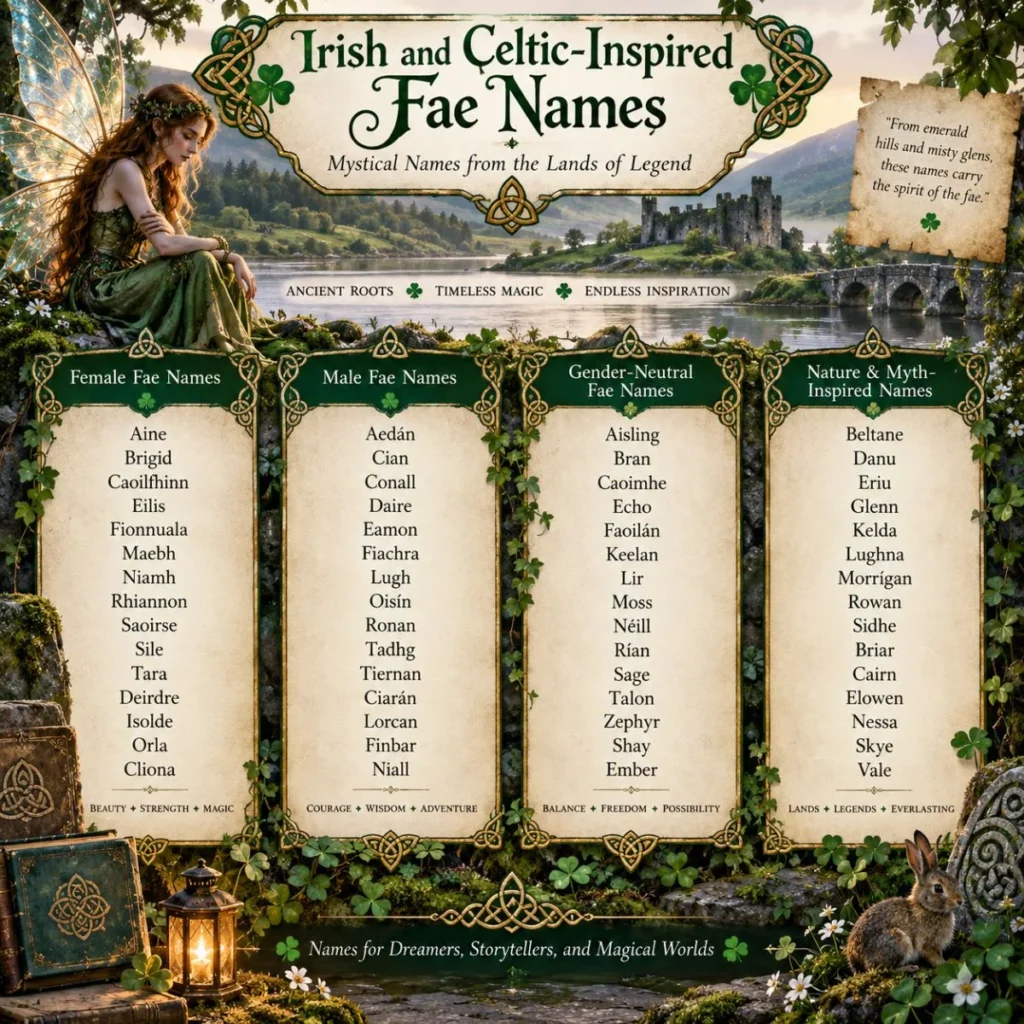
Irish and Celtic traditions are popular sources of fantasy naming, but it is important not to label every attractive Irish name as a traditional “fairy name.” Some names simply have Irish linguistic or mythological connections.
Aoibheann, for example, is an established Irish name derived from Old Irish elements associated with beauty and whiteness/blessing. A submitted mythological entry for the variant Aoibhann connects it specifically with a “Fairy Queen,” so the fairy association should be treated as a mythological tradition rather than the ordinary dictionary meaning of Aoibheann.
Good options include:
- Aoibheann — An authentically Irish choice with a graceful, luminous sound.
- Aisling — Poetic and strongly associated with Irish naming.
- Aoife — A classic Irish mythological name associated with a warrior figure.
- Maeve — A commanding name with strong Irish literary and legendary associations.
- Niamh — A distinctly Irish-looking choice with a legendary atmosphere.
- Ronan — Compact and versatile for a male or gender-neutral fantasy character.
- Brigid — An established Irish name with deep historical and religious associations.
- Róisín — A distinctly Irish choice with a softer sound.
- Eira — Short and elegant for a fantasy character.
- Fionn — A strong traditional choice with legendary associations.
If cultural authenticity matters, check the original language and pronunciation rather than treating “Celtic” as one interchangeable naming category.
Persian-Inspired Fae Names
Persian folklore provides a particularly useful naming tradition because parī is an established Persian word associated with fairy-like supernatural beings. Names built from this element therefore have a more direct linguistic connection to fairy imagery than many modern fantasy inventions.
- Pari — “Fairy, sprite, nymph.”
- Parisa — “Like a fairy.”
- Mahpari — “Moon fairy.”
- Parichehr — Built from parī and an element meaning face or appearance.
- Parinaz — Combines parī with an element associated with delight or comfort.
- Parivash — “Fairy-like.”
- Parizad — “Child of a fairy.”
These names can be excellent choices when you want a magical character without relying exclusively on the familiar European woodland aesthetic.
Unique Fantasy Fae Names
The following names are best treated as fantasy creations or fantasy-style constructions, rather than traditional historical names. That distinction matters because a name can sound convincingly fae without having an established meaning or cultural origin.
- Aelwen
- Elaris
- Vaelith
- Sylvara
- Aerwyn
- Elvarin
- Faelith
- Luneth
- Mirewyn
- Thalira
- Eiravel
- Velith
- Caelwyn
- Averelle
- Ilyra
- Mavelle
- Orlith
- Serelune
- Virelia
- Elarwen
These work particularly well for novels, role-playing games, fantasy worlds, and original characters because you are free to define their history, pronunciation, and meaning within your own setting.
Short Fae Names
Short names are easier to remember and usually work well for games, usernames, pets, tiny fairy characters, and quick-moving fantasy creatures.
- Fay
- Fae
- Pip
- Ash
- Wren
- Dew
- Fern
- Moss
- Lark
- Ivy
- Nyx
- Lumi
- Vale
- Sol
- Rune
- Briar
- Rain
- Dawn
- Fenn
- Wisp
If you want the name to be instantly recognizable, Fae, Fay, or Pip works well. For something more atmospheric, Wisp, Vale, or Rune creates a stronger fantasy impression.
Fae Names for D&D and Fantasy Games
A role-playing character needs more than a pretty name. The name should hint at personality, background, or role without becoming cumbersome during gameplay.
- Vaelis Thornmere — A polished name for an enigmatic court noble.
- Liora Mossvale — Suits a healer, druid, or woodland guide.
- Puck Briarstep — A playful name for a mischievous trickster.
- Vesper Nightbloom — Fits a secretive night-court character.
- Rowan Dewmere — Works for a gentle forest wanderer.
- Aurelia Sunpetal — Suits a radiant or optimistic fae.
- Fenn Hollowreed — A stranger, wilder choice for a marsh-dwelling character.
- Nimue Starfall — Good for a mystical spellcaster.
- Briar Moonthorn — Fits a beautiful but dangerous character.
- Oberon Vale — A commanding name for a fae noble.
- Sylvie Greenbriar — A softer woodland character name.
- Elaris Duskwind — Suitable for an elusive traveler.
- Pari Silverleaf — Blends a genuine fairy-related name with a fantasy surname.
- Maeve Thornwillow — Strong enough for a warrior or court leader.
- Luneth Everdew — A more overtly fantastical option.
For games, consider whether other players can pronounce the name quickly. A beautiful name that everyone has to ask you to repeat can become less useful at the table.
Fae Last Names and Court Names
A surname can establish where a fae comes from or what kind of magic they possess. Nature-based compounds work especially well, but the two parts should create a clear image rather than simply stacking random fantasy words.
- Moonvale
- Thornmere
- Silverleaf
- Dewfall
- Mossvale
- Briarwood
- Starbloom
- Willowmere
- Nightbriar
- Sunpetal
- Ravenshade
- Mistvale
- Hollowbrook
- Emberthorn
- Duskwood
- Frostwillow
- Rosemere
- Whisperwind
- Greenbriar
- Moonthorn
For a royal fae court, Moonvale, Silverleaf, and Starbloom feel elegant. A darker court might use Nightbriar, Ravenshade, or Emberthorn.
How to Choose the Right Fae Name
The strongest fae name should match the character rather than merely sound magical.
Start with the character’s personality. A cheerful garden sprite might suit Poppy, while a calculating court noble could fit Vesper or Maeve.
Next, consider the environment. Forest characters naturally pair with names such as Rowan, Fern, Moss, or Willow. A celestial character might fit Luna, Lyra, or Vesper.
Think about sound, too. Soft consonants and flowing vowels can create an ethereal feeling, while sharper sounds can make a character feel more dangerous. Compare the gentle impression of Liora with the harder edge of Thorn.
Finally, say the complete name aloud. This is particularly important for character names with surnames. Liora Mossvale is easy to say and remember, while an excessively long combination may become difficult to use repeatedly.
How to Create Your Own Fae Name
You do not need a random name generator to create a convincing fantasy name. A simple naming formula can give you more control over the character.
Nature + Personality
Combine something from nature with a trait or impression.
- Willow Grace
- Briar Swift
- Moss Gentle
- Ember Bright
Celestial Element + Natural Element
This works especially well for magical courts.
- Moonbriar
- Starwillow
- Dawnmere
- Mistluna
Invented First Name + Nature Surname
Create a lyrical first name, then give it a grounded surname.
- Elaris Thornmere
- Vaelith Moonvale
- Ilyra Silverleaf
- Serelune Dewfall
Real Name + Fantasy Epithet
This approach gives the character a recognizable first name while adding a stronger fantasy identity.
- Fay of Moonvale
- Maeve Thornkeeper
- Pari of the Silver Grove
- Rowan Starwatcher
When inventing a name, avoid adding random apostrophes, excessive vowels, or unusual spellings simply to make it look fantastical. A memorable name usually needs less decoration than you might expect.
Frequently Asked Questions
What are fae names?
Fae names are names associated with fairies, fairy folklore, magical beings, or modern fantasy interpretations of the fae. They can be real names with fairy-related meanings, traditional mythological names, nature names, or completely fictional creations.
What is a good fae name?
Fay, Pari, Elowen, Nimue, Vesper, Briar, Rowan, and Aurelia are strong choices because they create distinct magical impressions without being excessively complicated.
What name actually means fairy?
Fay has a documented English connection to the word fay, meaning “fairy.” Pari means “fairy, sprite, nymph” in Persian, while Parisa means “like a fairy.”
Are fae names only for girls?
No. Fae naming can be completely gender-neutral. Names such as Rowan, Ash, Wren, Vesper, Moss, Lark, and Vale can work for characters of different genders. Fantasy naming does not need to follow conventional human naming categories.
What makes a name sound fae?
Nature, moonlight, flowers, forests, unusual but pronounceable sounds, and an old-world or lyrical quality can all create a fae impression. However, the name does not need to contain words such as “fairy,” “magic,” or “shadow” to feel magical.
Are all Celtic-inspired fae names traditional fairy names?
No. Celtic languages and folklore are major sources of fantasy inspiration, but an Irish, Welsh, or Scottish name is not automatically a traditional fairy name. For accurate cultural naming, distinguish established names and folklore figures from modern fantasy inventions.
What are good fae names for D&D?
Vesper Nightbloom, Puck Briarstep, Liora Mossvale, Oberon Vale, Nimue Starfall, and Briar Moonthorn work well because each gives a player an immediate personality or setting cue while remaining practical to pronounce.
Can I create my own fae name?
Absolutely. Try combining a natural image with a personality trait, celestial element, place, or magical epithet. For example, Moon + Briar becomes Moonbriar, while an invented first name such as Elaris can be paired with Thornmere to create Elaris Thornmere.
Conclusion
The best fae names balance magic with personality. For a traditional fairy feeling, Fay and Pari offer genuine connections to fairy-related meanings. For woodland characters, names such as Willow, Rowan, Briar, and Fern create an immediate natural atmosphere. If your character belongs to a darker court, Vesper, Nyx, Thorn, or Raven can give the name more mystery.
For completely original fantasy characters, focus less on making the name complicated and more on making it memorable. A well-chosen sound, a strong natural image, and a clear character identity can turn a simple name into one that genuinely feels as though it belongs in the world of the fae.

Muhammad Yousaf is a content writer and naming researcher at NamesLixa. He focuses on researching and publishing creative, meaningful, and easy-to-understand name collections for babies, pets, teams, businesses, gaming, and more. His mission is to help readers find the perfect name with confidence through reliable and informative content.