

European girl names offer an unusually wide range of styles. Across the continent, you can find elegant French choices, lyrical Italian names, strong Nordic picks, graceful Spanish options, and distinctive Slavic favorites. That variety makes European naming especially useful when you want a name that feels familiar without being ordinary.
The term European girl name covers names from many languages and traditions rather than one single naming system. Some choices have ancient Greek or Latin roots, while others come from Germanic, Celtic, Scandinavian, Romance, or Slavic languages. Some are strongly associated with a particular country; others have traveled successfully across borders.
Below, you’ll find a carefully selected collection organized by style and regional flavor, with meanings and brief notes where they add useful context. The goal is not simply to give you a long list, but to help you recognize which names fit the personality, sound, and heritage you have in mind.
Best European Girl Names
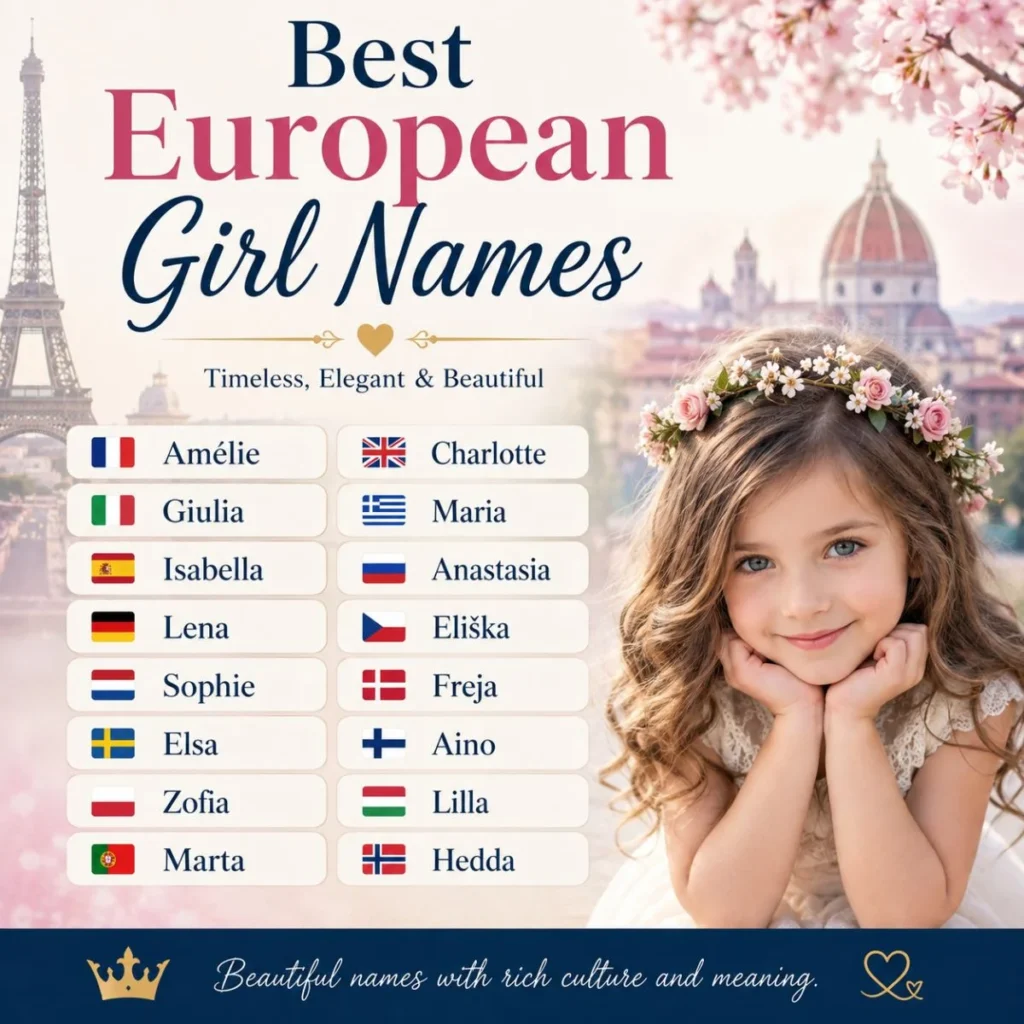
These are strong all-around choices if you want a name that sounds elegant, recognizable, and distinctly European. Many work comfortably across different languages, while others retain a clear regional identity.
- Amalia — A graceful Germanic name associated with work and industriousness; it has a polished continental sound.
- Beatrice — Traditionally connected with the idea of bringing happiness or blessedness; refined without feeling overly formal.
- Clara — A bright, classic Latin-rooted name associated with clarity and brightness.
- Elena — A widely used European form related to Helen, traditionally associated with light or a shining one.
- Emilia — A graceful name with Latin roots that feels equally at home in Italy, Poland, Germany, and other European settings.
- Freya — A Scandinavian name associated with the Norse goddess Freyja, giving it a strong mythological character.
- Helena — An enduring European classic with ancient Greek roots and a regal, literary feel.
- Isabelle — A French form related to Elizabeth, traditionally interpreted as “pledged to God.”
- Livia — An elegant Roman name with a concise, sophisticated sound.
- Matilda — A Germanic name traditionally interpreted as “strength in battle,” balancing a soft sound with a powerful meaning.
- Nora — A compact European favorite often treated as a short form of names such as Eleanor or Honora.
- Valentina — The feminine form of Valentinus, associated with strength and health.
- Victoria — A Latin name meaning “victory,” with a long association with European royalty and history.
- Vivienne — A French-influenced form associated with the Latin root for “alive,” giving it a lively and elegant character.
- Zara — A short, internationally familiar choice with several linguistic histories, making its exact origin and meaning dependent on the naming tradition.
European naming resources similarly emphasize that the category spans French, Spanish, Italian, German, Greek, Scandinavian, Slavic, and other traditions rather than representing one uniform style.
Beautiful European Girl Names With Meanings
If meaning matters as much as sound, these choices give you a useful starting point. Meanings can vary across languages and historical forms, so the descriptions below use the most commonly associated interpretations rather than treating every etymology as absolute.
- Adelaide — From Germanic elements associated with nobility and kind or noble character.
- Alba — A Latin-rooted name associated with dawn, brightness, or whiteness.
- Astrid — A Scandinavian name traditionally formed from elements associated with divine beauty or strength.
- Aurora — Latin for “dawn,” making it a natural choice for a name connected with light and new beginnings.
- Bianca — An Italian form meaning “white” or “fair.”
- Celeste — From Latin caelestis, meaning “heavenly” or “of the sky.”
- Diana — The Roman goddess of the moon and the hunt; the name carries an unmistakably classical character.
- Estelle — A French name ultimately related to the Latin stella, meaning “star.”
- Felicity — From Latin felicitas, associated with happiness, good fortune, and joy.
- Irene — From Greek Eirene, meaning “peace.”
- Lucia — A feminine form connected with Latin lux, meaning “light.”
- Margot — A French form related to Margaret, ultimately associated with the Greek word for “pearl.”
- Nadia — Commonly used as a Slavic form associated with the idea of “hope.”
- Petra — The feminine form of Peter, ultimately from Greek petros, meaning “rock.”
- Rosa — A classic European floral name associated with the rose.
- Sofia — A European form of Sophia, from Greek sophia, meaning “wisdom.”
- Stella — Latin for “star,” giving the name a simple celestial meaning.
- Valeria — A Roman name associated with the Latin valere, “to be strong” or “to be healthy.”
- Veronica — A long-established European Christian name with a complex historical development and traditional associations with “true image.”
- Zofia — The Polish form of Sophia, traditionally associated with “wisdom.”
Elegant European Girl Names
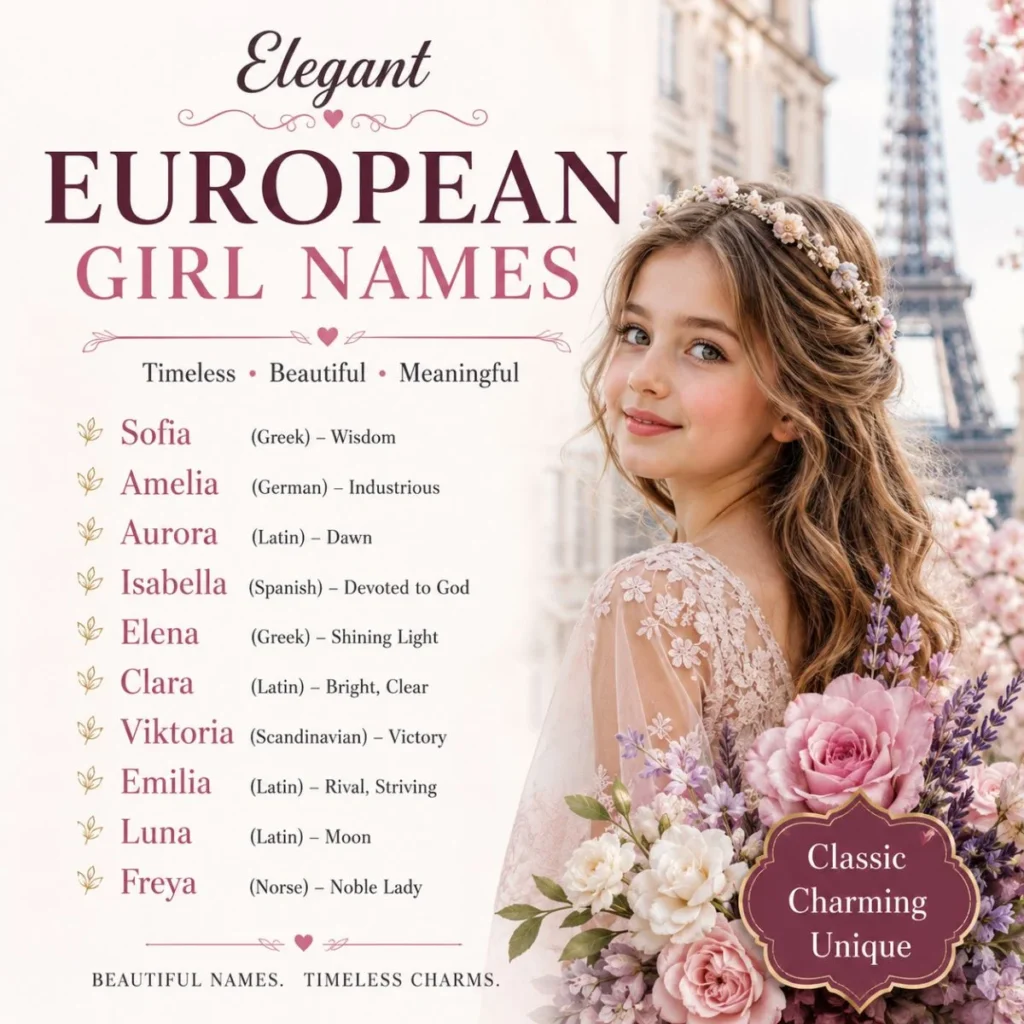
For a sophisticated, almost timeless feeling, these names have polished sounds and strong historical associations. They suit parents who want something graceful without choosing an overly elaborate name.
- Anastasia — A Greek-rooted name meaning “resurrection,” with a long history across Eastern Europe.
- Cecilia — A Roman family name that became especially prominent through Christian tradition and Saint Cecilia.
- Eleonora — A richly styled European form related to Eleanor, with a distinctly aristocratic sound.
- Genevieve — A French classic associated with Saint Geneviève, the patron saint of Paris.
- Josephine — The feminine form of Joseph, with strong French and broader European associations.
- Leonora — A lyrical form related to Eleanor that feels romantic and vintage.
- Louisa — A feminine form related to Louis, traditionally associated with famous warrior or renowned characteristics through its Germanic roots.
- Madeleine — A French form associated with Magdalene, familiar yet unmistakably French in character.
- Marguerite — The French form of Margaret, traditionally associated with the pearl.
- Rosalie — A romantic European floral name related to rose.
- Seraphine — A feminine form connected with the biblical seraphim and traditionally associated with “fiery.”
- Sylvie — A French form related to Silvia, from Latin silva, “forest.”
- Therese — A classic European form of Teresa, especially associated with French and German naming traditions.
- Verena — A traditional European name with a long history in German-speaking regions and Switzerland.
- Wilhelmina — A formal Germanic feminine form related to William, carrying an old-world, stately quality.
Cute and Charming European Girl Names
Short names can feel especially appealing when you want something affectionate, easy to say, and memorable. These choices have a lighter personality while still having established European connections.
- Anouk — A compact French and Dutch-associated form of Anne.
- Elsa — A familiar European form related to Elisabeth, with a bright and friendly sound.
- Fia — A short Scandinavian-associated name that feels modern and playful.
- Ines — A European form of Agnes, particularly familiar in Spanish, Portuguese, French, and other languages.
- Leni — A friendly short form associated with names such as Helena or Magdalena.
- Lia — A concise form used in several European languages and related to names such as Leah.
- Lotte — A German and Dutch short form of Charlotte.
- Mila — A Slavic name built from the element mil, associated with graciousness, kindness, or dear.
- Nina — A compact international name used across many European countries, with multiple possible histories.
- Noemi — A European form of Naomi that feels soft and melodic.
- Romy — A short European favorite associated with names such as Rosemarie or Romilda.
- Sisi — A playful nickname famously associated with Empress Elisabeth of Austria.
- Tessa — A familiar short form associated with Theresa or Teresa.
- Zosia — A Polish diminutive of Zofia, giving the traditional Sophia family a distinctly Polish character.
Unique European Girl Names
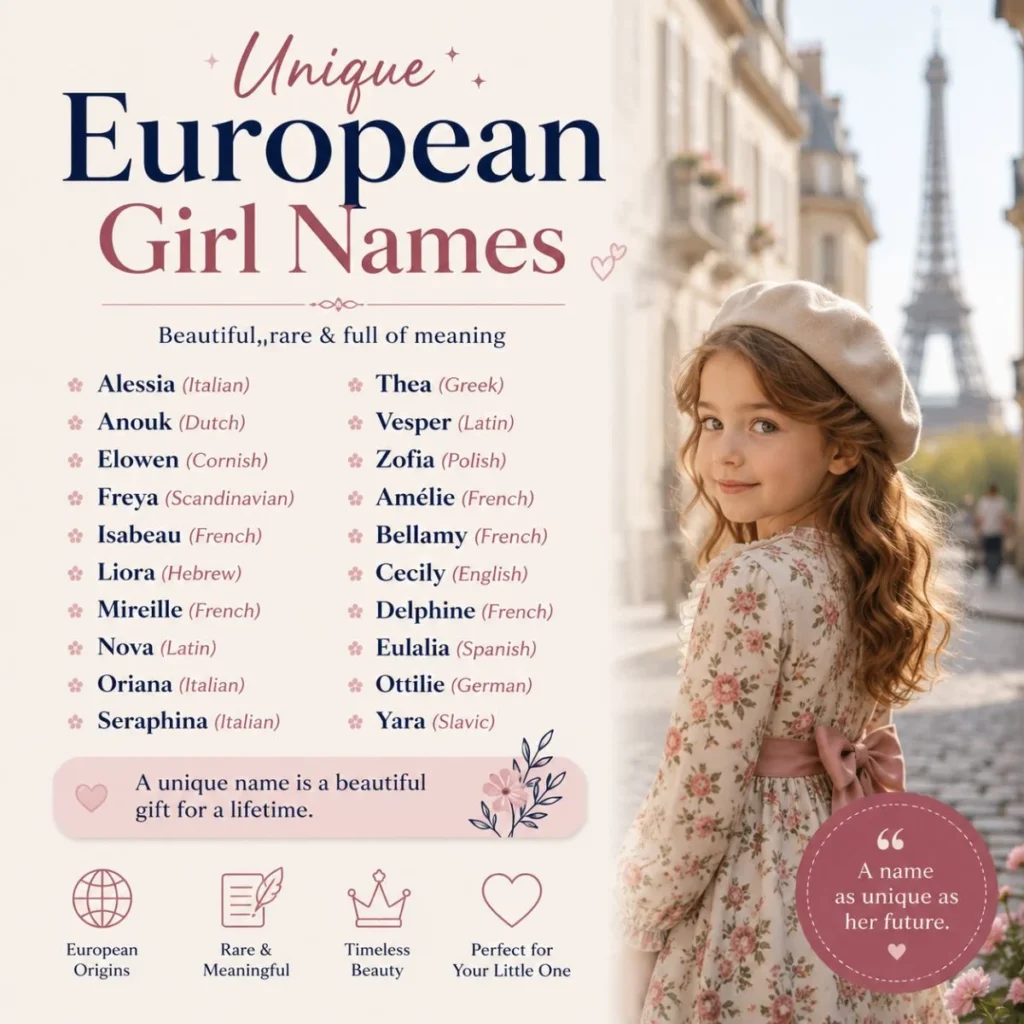
A unique name does not need to be invented. Europe’s many regional languages provide plenty of established choices that remain less familiar internationally.
- Aino — A Finnish name with a distinctly Nordic sound and strong literary associations.
- Apolline — A French feminine form related to Apollo, offering an unusual classical feel.
- Aurelia — A Roman name connected with Latin aureus, “golden.”
- Cosima — A feminine form related to Cosmas, with Greek roots and an unusual Italian and German cultural presence.
- Eulalia — An ancient Greek-rooted name traditionally associated with “sweetly speaking.”
- Iolanthe — A literary and European form associated with the violet flower in Greek-derived interpretation.
- Leocadia — A rare traditional European name associated particularly with Spanish naming history.
- Madelief — A Dutch floral name referring to the daisy.
- Ondine — A French literary name associated with water spirits in European folklore.
- Solveig — A Scandinavian name traditionally interpreted through Old Norse elements associated with the sun and strength or path.
- Thessaly — A Greek regional name with an ancient geographic connection.
- Zinnia — A floral name that has become familiar internationally while retaining a distinctive sound.
Some European naming collections specifically highlight less familiar regional choices such as Puck, Saga, Iolanthe, Madelief, Milou, and Thessaly as examples of names that can feel distinctive outside their home cultures.
French European Girl Names
French names often appeal to people who want a soft, refined sound. The following choices range from familiar classics to names that feel more distinctly French.
- Amélie — A French form related to Amelia and Amalia, with a bright, graceful sound.
- Anaïs — A distinctive French name with an elegant two-syllable rhythm.
- Camille — A classic French name with a sophisticated, understated quality.
- Céleste — A French form associated with the Latin word for “heavenly.”
- Chloé — A Greek-rooted name meaning “young green shoot,” widely established in French-speaking Europe.
- Élodie — A melodic French name with a distinctly romantic sound.
- Fleur — French for “flower,” making its meaning immediately recognizable.
- Juliette — The French form of Juliet, forever linked with Shakespearean romance.
- Manon — A traditional French diminutive of Marie or related names, now firmly established as a given name.
- Margaux — A French spelling variant of Margot.
- Océane — A French feminine name connected with the ocean.
- Solène — A French name with an elegant, uncommon sound.
- Victoire — The French form of Victoria, meaning “victory.”
Italian European Girl Names
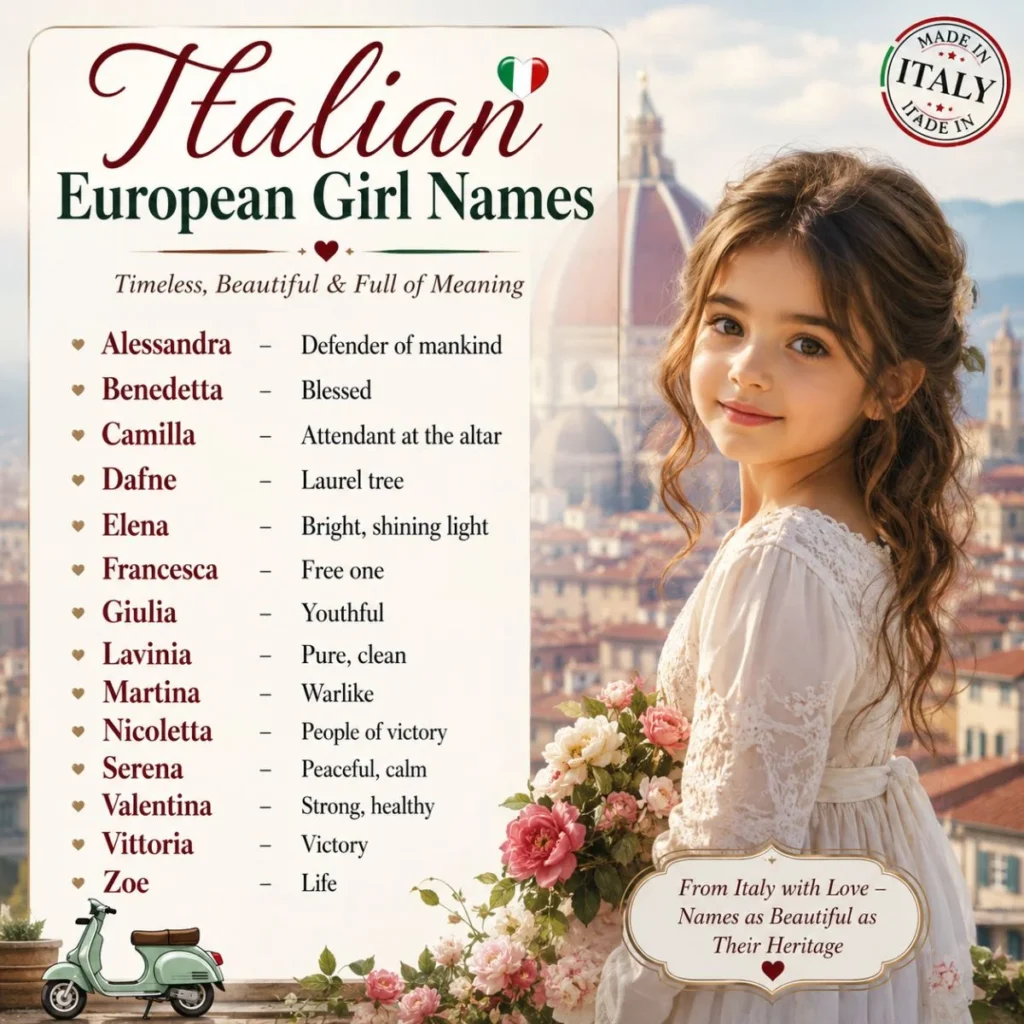
Italian names often have open vowels and a musical rhythm. They can feel romantic and expressive while remaining highly recognizable.
- Alessia — The Italian feminine form related to Alessio and Alexander, traditionally associated with defending or protecting.
- Beatrice — The Italian form of Beatrix, associated with blessedness or bringing happiness.
- Carlotta — The Italian form of Charlotte.
- Chiara — The Italian form related to Clara, traditionally associated with brightness or clarity.
- Francesca — The feminine Italian form of Francesco.
- Giada — The Italian word for jade, used as a given name.
- Giulia — The Italian form of Julia, connected with the ancient Roman Julian family.
- Ginevra — The Italian form of Guinevere, with a distinctive medieval and literary character.
- Ludovica — The Italian feminine form of Ludovic/Louis.
- Noemi — An Italian form of Naomi that has a particularly smooth Italian pronunciation.
- Serena — A Latin-rooted name associated with calm, clear, or serene qualities.
- Vittoria — The Italian form of Victoria, meaning “victory.”
Spanish and Portuguese European Girl Names
Spanish and Portuguese naming traditions offer warm, expressive names with strong vowel sounds. Many also travel easily across Spanish-speaking communities beyond Europe.
- Aitana — A Spanish place-name associated with the Aitana mountain in Alicante.
- Alba — A Spanish and Catalan favorite associated with dawn.
- Carmen — A classic Spanish name with deep cultural and literary associations.
- Clara — A widely used European name that feels natural in both Spanish and Portuguese contexts.
- Esperanza — Spanish for “hope,” making the meaning especially transparent.
- Inés — The Spanish form of Agnes.
- Jimena — A Spanish feminine name with medieval Iberian associations.
- Marisol — A Spanish compound traditionally associated with María de la Soledad.
- Paloma — Spanish for “dove,” giving the name a peaceful symbolic quality.
- Pilar — A Spanish name associated with the Virgin of the Pillar and strongly connected with Spanish tradition.
- Valeria — A polished Latin-rooted choice widely used in Spain and elsewhere.
- Ximena — A variant of Jimena that offers a distinctive initial sound.
- Yolanda — A traditional European name with medieval French and Germanic historical connections.
Scandinavian and Nordic Girl Names
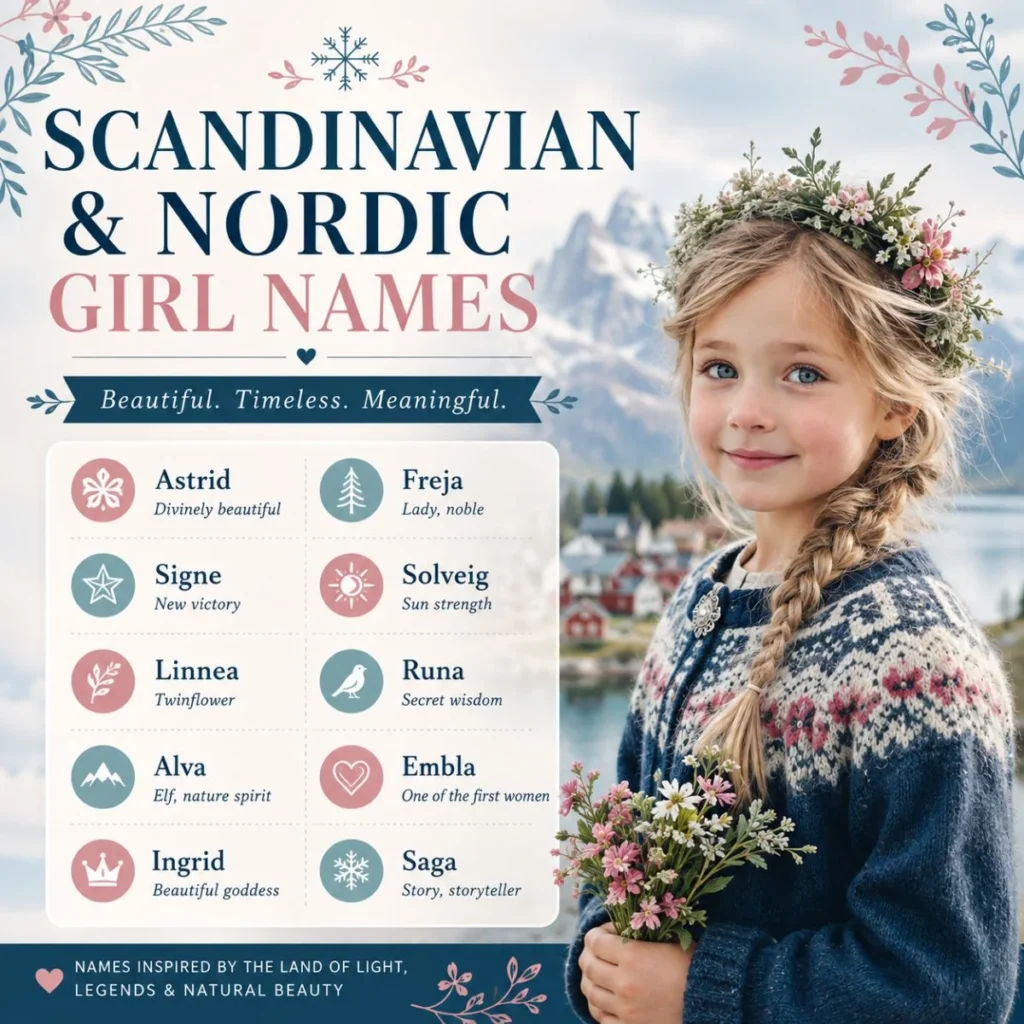
Nordic names often combine concise sounds with meanings connected to nature, strength, beauty, or mythology. They work particularly well if you want something distinctive without sounding invented.
- Alva — A Scandinavian-associated name with a light, airy sound.
- Astrid — A historic Scandinavian choice traditionally associated with divine beauty or strength.
- Freja — A Scandinavian spelling of Freya, connected with the Norse goddess Freyja.
- Frida — A Nordic and Germanic name associated with peace or beloved qualities through related Germanic elements.
- Greta — A Scandinavian short form of Margaret.
- Ingrid — A classic Scandinavian name built from Old Norse elements associated with Ing and beauty.
- Linnea — A Swedish botanical name inspired by the twinflower, named after Carl Linnaeus.
- Sigrid — A Norse name traditionally interpreted as “beautiful victory” or “fair victory.”
- Solveig — A distinctive Norwegian and Scandinavian choice with an unmistakably Nordic sound.
- Sunniva — A Scandinavian form of an Old English name associated with the sun and gift elements.
- Thyra — A traditional Scandinavian name with royal and historical associations.
- Vigdis — An Old Norse name combining elements associated with battle and goddess.
Sigrid and other Scandinavian choices appear in broader European name collections, illustrating how Nordic names can stand apart while remaining established rather than invented.
Eastern European and Slavic Girl Names
Eastern European naming traditions provide especially good options when you want a name with character, history, and a less familiar sound. Spelling and pronunciation can vary between countries, so check the local form if cultural accuracy is important.
- Alina — A widely used European name with several possible linguistic histories.
- Danica — A Slavic name traditionally associated with the morning star.
- Daria — A feminine form related to Darius, historically connected with Persian roots and later widespread in Slavic Europe.
- Jelena — A South Slavic form related to Helena.
- Katarina — A European form of Katherine, traditionally associated with “pure.”
- Ksenia — A Slavic form of Xenia, from Greek and associated with hospitality or a guest.
- Milena — A Slavic name built from mil, associated with graciousness or beloved qualities.
- Nadezhda — A traditional Russian and Bulgarian form meaning “hope.”
- Natasha — A Russian diminutive of Natalia.
- Oksana — A Ukrainian form related to Xenia.
- Svetlana — A Slavic name traditionally connected with light or brightness.
- Tatiana — A name of Roman origin that became especially established in Eastern Europe.
- Vesna — A Slavic name associated with spring and renewal.
- Zlata — A Slavic name connected with “golden” or “gold.”
Short European Girl Names
Short names are practical because they are easy to spell, say, and remember. They can also balance a longer surname particularly well.
- Ada — A concise European classic with Germanic associations of nobility.
- Alma — A short, soulful name with several historical and linguistic associations.
- Eira — A Welsh name associated with snow, making it a lovely nature-inspired choice.
- Elsa — A compact form related to Elisabeth.
- Esme — A French-associated name often connected with the idea of being esteemed or loved.
- Fia — A brief Scandinavian-associated choice with a playful sound.
- Iris — A Greek-rooted name meaning “rainbow” and also the name of a flower.
- Lara — A short European classic with Roman and Russian naming histories.
- Lea — A compact form used in several European languages.
- Lena — A familiar short form associated with Helena, Magdalena, and other names.
- Maja — A European spelling used especially in Scandinavian and Slavic countries.
- Mila — A short Slavic name associated with graciousness and affection.
- Nina — A concise international name with multiple possible origins.
- Rosa — A simple floral classic.
- Vera — A compact name associated with “faith” in Slavic usage and with “true” in Latin-based interpretation.
- Zoe — From Greek zoē, meaning “life.”
Strong European Girl Names
If you want a name with a bold personality, consider choices whose meanings, historical associations, or sounds suggest strength and confidence.
- Adelaide — Noble in origin and stately in sound.
- Astrid — Crisp and commanding, with historic Scandinavian roots.
- Brunhilda — A powerful Germanic name associated with armor and battle.
- Clotilde — A historic Germanic name connected with fame and battle.
- Freya — Mythological and unmistakably Nordic.
- Matilda — Combines a graceful sound with the traditional meaning “strength in battle.”
- Petra — A compact name associated with rock and firmness.
- Regina — Latin for “queen,” giving it an unmistakably regal quality.
- Sigrid — A strong Norse name associated with victory.
- Valentina — Connected with strength and health through its Latin roots.
- Victoria — Directly means “victory.”
- Wilhelmina — A substantial Germanic choice with a commanding vintage character.
Romantic European Girl Names
For a softer, literary, or romantic feeling, these names bring together flowing sounds and long-standing European associations.
- Anastasia — Elaborate and graceful, with ancient Greek roots.
- Arabella — A romantic European classic with an elegant rhythm.
- Clementine — A soft name connected with the Latin adjective for merciful or gentle.
- Evangeline — A lyrical name derived from Greek roots associated with “good news.”
- Florence — A classic name associated with the Italian city and with Latin roots connected to flourishing.
- Genevieve — French, historic, and unmistakably elegant.
- Juliette — Romantic through both sound and literary association.
- Leonora — Flowing and vintage, with an aristocratic feel.
- Rosalie — A delicate European floral choice.
- Seraphine — Dramatic without being harsh, with biblical roots.
- Valentina — Warm and expressive with a strong underlying meaning.
- Vivienne — Lively and sophisticated, especially suited to a vintage-modern style.
European Girl Names Inspired by Nature
Nature-inspired naming is not limited to English. European languages offer beautiful choices connected with flowers, stars, water, seasons, and the landscape.
- Alba — “Dawn,” suggesting the first light of day.
- Aurora — “Dawn,” with a distinctly celestial feel.
- Fleur — French for “flower.”
- Flora — A Latin floral name and the name of the Roman goddess of flowers and spring.
- Iris — Connected with both the rainbow in Greek mythology and the iris flower.
- Linnea — Inspired by the Swedish twinflower.
- Luna — Latin for “moon,” now widely used across Europe.
- Marina — A Latin-derived name associated with the sea.
- Ondine — A literary French name associated with water.
- Paloma — Spanish for “dove.”
- Rosa — Associated with the rose.
- Vesna — A Slavic name connected with spring.
How to Choose the Right European Girl Name
With so many European naming traditions, narrowing the list can be harder than finding ideas. A practical approach is to judge each favorite on sound, meaning, cultural fit, and everyday usability.
Start with the region or language
If the name is intended to honor family heritage, begin with the relevant country or language. A French name, for example, may have a different pronunciation from its Italian or Spanish relative even when the names share an ancient root.
Regional context also helps you avoid treating Europe as a single culture. Scandinavian, Balkan, Celtic, Romance, Germanic, and Slavic traditions have their own histories and naming conventions.
Check pronunciation
Say the name together with the surname several times. Pay attention to difficult consonants, unusual letter combinations, and whether the pronunciation changes significantly in your preferred language.
A beautiful name that constantly needs correction may become frustrating in everyday use.
Look beyond the literal meaning
Meaning matters, but it should not be the only deciding factor. A name with a beautiful definition might sound awkward with the surname, while a name with a less dramatic meaning might have exactly the right rhythm.
Consider the whole name:
- How does it sound with the surname?
- Does the spelling feel intuitive?
- Is the pronunciation reasonably clear?
- Does the nickname work?
- Will the name suit both childhood and adulthood?
- Does its cultural background match your reason for choosing it?
Decide how distinctive you want to be
“European” does not automatically mean “rare.” Some European names are extremely familiar internationally, while others remain strongly regional.
For a familiar choice, names such as Clara, Elena, Sofia, Lucia, or Victoria offer broad recognition. If you prefer something less expected, consider Apolline, Madelief, Solveig, Zlata, or Thessaly.
Check the cultural context
If you choose a name because it comes from a particular European culture, learn how people in that culture actually use it. Look at local spelling, pronunciation, diminutives, and gender conventions.
That small amount of research can make a meaningful difference, especially when a name has several regional forms.
European Girl Names by Personality
Sometimes choosing a name by personality is easier than choosing by country. Think about the feeling you want the name to communicate.
Gentle personality
- Alma — Warm and understated.
- Clara — Bright and delicate without being childish.
- Elsa — Friendly and light.
- Iris — Soft with a colorful natural association.
- Lia — Simple and graceful.
- Mila — Affectionate and warm.
- Nora — Familiar, gentle, and polished.
- Rosalie — Romantic and floral.
For a confident personality
- Astrid — Crisp and powerful.
- Freya — Mythological and self-assured.
- Matilda — Strong meaning beneath a classic sound.
- Petra — Solid and concise.
- Regina — Literally associated with a queen.
- Sigrid — Distinctive and commanding.
- Valentina — Strong and elegant.
- Victoria — Directly associated with victory.
For a creative personality
- Apolline — Unusual and classical.
- Cosima — Artistic and distinctive.
- Iolanthe — Rare and literary.
- Linnea — Botanical and Scandinavian.
- Ondine — Dreamlike and water-inspired.
- Seraphine — Dramatic and lyrical.
- Solveig — Nordic and memorable.
- Thessaly — Geographic and ancient in character.
European Girl Names That Work Internationally
If the child will grow up around several languages, pronunciation and spelling become especially important. Names with familiar sounds can travel more easily between countries.
Some particularly versatile choices include:
- Alba — Short and recognizable across several European languages.
- Clara — Familiar in Romance, Germanic, and English-speaking contexts.
- Elena — Easy to recognize while retaining regional flexibility.
- Iris — Short, established, and internationally familiar.
- Lara — Compact and easy to pronounce in many languages.
- Lucia — Distinctively European with several established pronunciations.
- Mila — Short, modern, and strongly established in Slavic Europe.
- Nora — Simple and broadly recognizable.
- Sofia — A widely established European form with an easy international presence.
- Valeria — Elegant while remaining relatively straightforward to pronounce.
- Vera — Short, classic, and culturally established in several European traditions.
- Victoria — Familiar across Europe and beyond.
How to Create Your Own European-Style Name List
Rather than inventing random names, you can build a thoughtful shortlist from real European naming traditions.
Start by choosing one of these approaches:
- Country + classic — Pick a country, then explore its established traditional names.
- Language + meaning — Choose a meaning such as “light,” “hope,” “peace,” or “strength,” then look for established names with that meaning in a specific language.
- Region + nature — Search a particular European language for floral, celestial, seasonal, or landscape-related names.
- Traditional name + local form — Compare related versions such as Sofia/Sophie/Sofija, Julia/Giulia, or Clara/Chiara.
- Family heritage + modern sound — Look for a traditional name from your heritage that still feels comfortable today.
For example, if you want a name connected with light, you might explore Clara, Lucia, Elena, Alba, or Aurora. If strength is the priority, Matilda, Valentina, Victoria, Petra, or Astrid offer different interpretations of that theme.
This approach produces names with genuine linguistic or cultural roots instead of artificial combinations that merely sound European.
Frequently Asked Questions
What is a European girl name?
A European girl name is a feminine given name used in a European country or rooted in one of Europe’s many languages and naming traditions. The category includes names from Romance, Germanic, Celtic, Greek, Scandinavian, Slavic, and other European traditions.
Because Europe contains many distinct cultures, there is no single definition that makes one name “European” and another name “not European.” Some names originated elsewhere but became firmly established in European countries, while others have ancient European roots and remain regionally specific.
What are some beautiful European girl names?
Popular choices include Clara, Elena, Amalia, Beatrice, Lucia, Sofia, Valentina, Aurora, Astrid, and Matilda. The best choice depends on whether you prefer classic, romantic, Nordic, Mediterranean, or distinctive styles.
What is a unique European girl name?
Some less familiar established choices include Apolline, Cosima, Iolanthe, Madelief, Ondine, Solveig, Thessaly, and Zlata. A name can feel unique without being invented; regional European traditions provide many genuine alternatives to familiar international names.
What are some short European girl names?
Good short choices include Ada, Alba, Elsa, Fia, Iris, Lara, Lea, Lena, Mila, Nora, Rosa, Vera, and Zoe. Short names are especially practical when you want an easy-to-spell first name or have a longer surname.
Which European girl names have strong meanings?
Victoria means “victory,” Irene means “peace,” Aurora means “dawn,” Sofia means “wisdom,” Petra is associated with “rock,” and Valentina is connected with strength and health. Matilda also stands out for its traditional association with strength in battle.
What are some Scandinavian girl names?
Notable Scandinavian choices include Astrid, Freya, Frida, Ingrid, Linnea, Sigrid, Solveig, Sunniva, and Thyra. These names can be especially appealing if you want Nordic history, mythology, or nature associations.
Are European girl names good for multilingual families?
Yes, although pronunciation should be checked carefully. Names such as Clara, Elena, Iris, Lara, Mila, Nora, Sofia, and Victoria are relatively adaptable across languages. For a family using several languages, say the complete name aloud in each language before making a final decision.
How do I choose between a common and a rare European girl name?
Consider how much recognition you want. A familiar name such as Clara or Sofia usually requires little explanation, while a rarer choice such as Apolline or Solveig can feel more distinctive. If cultural heritage matters, authenticity and regional connection may be more important than popularity.
Conclusion
The best European girl name is not necessarily the rarest or the most elaborate. It is the one whose sound, meaning, cultural background, and everyday usability all feel right together.
For a timeless choice, consider Clara, Beatrice, Elena, Victoria, or Matilda. If you prefer something softer, Alma, Mila, Rosalie, or Iris may fit better. For a distinctive regional character, explore Solveig, Madelief, Apolline, Zlata, or Cosima.
Europe’s naming traditions are broad enough to offer almost every style—from understated and modern to romantic, mythological, floral, and deeply traditional. Take your favorite few names, say them aloud with the surname, check their cultural context, and choose the one that feels natural rather than simply unusual.

Muhammad Yousaf is a content writer and naming researcher at NamesLixa. He focuses on researching and publishing creative, meaningful, and easy-to-understand name collections for babies, pets, teams, businesses, gaming, and more. His mission is to help readers find the perfect name with confidence through reliable and informative content.